Start with the surface
Road and track running wants a cushioned sole with a fairly smooth tread. Uneven ground, field edges and village roads want a deeper tread and a firmer, more stable base — a soft road shoe rolls the ankle more easily there.
Gym and training wants something flatter and more stable. Running shoes are built to roll forward; that is the wrong behaviour for lifting or lateral movement.
Fit in the evening, with the right socks
Feet are at their largest at the end of the day and swell further during exercise. A shoe that fits perfectly at 10am can be painfully tight at the end of a run.
Leave roughly a thumb’s width at the toe. The heel should not lift when you walk, and the width should feel snug without pinching. Lacing can fine-tune the midfoot, but it cannot fix a shoe that is the wrong width.
Walk in them on a hard floor
Carpet flatters every shoe. Take a few steps on the hard floor rather than only on the mat, and walk rather than stand — problems show up in motion.
If something rubs in the shop, it will not “break in”. Uppers soften slightly; shape and size do not change.
Know when a pair is finished
The usual sign is not the upper, which often looks fine, but the midsole — the layer between the tread and your foot. When it stops springing back, the cushioning is gone even though the shoe looks wearable.
Set the shoe on a flat surface and look at it from behind. If it leans noticeably to one side, the midsole has collapsed unevenly, and continuing in it puts uneven load through your knees.
Come and try a few pairs
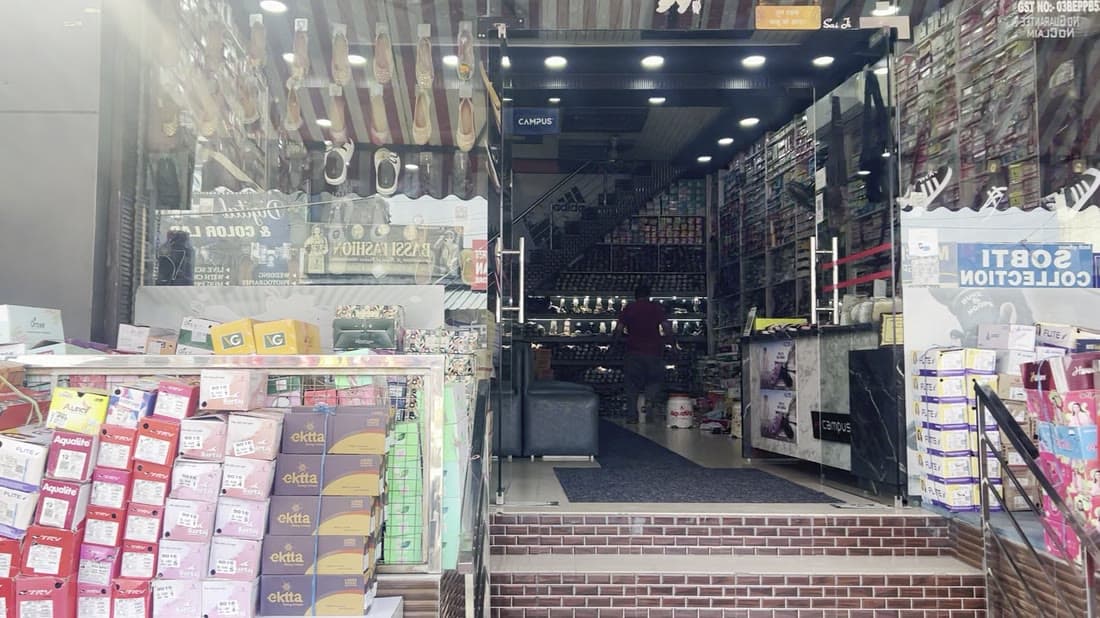
Fit is the part that cannot be settled online. The shop is open daily except the last Sunday of the month, and there are benches down the middle for exactly this.